You meet a buyer in a park. They've seen your listing, they like the bike, and they're ready to pay. Then they ask: "Can you prove it's actually yours?" You pull out an old receipt from a folder: faded, crumpled, with no serial number on it. The buyer hesitates. You both know this piece of paper proves almost nothing.
This scene plays out thousands of times every summer across Europe. The second-hand bicycle market is worth over $47 billion globally, and it keeps growing. But unlike cars, motorcycles, or even boats, bicycles have no standard system for proving who owns them. That gap creates problems for honest sellers, cautious buyers, and anyone who's ever had a bike stolen.
Bike Registry was built to close that gap. Here's how ownership transfers work, and why they matter, especially during summer when bike sales peak.
The problem: bikes have no paper trail
When you sell a car, there's a registration certificate. A national vehicle register tracks who the registered keeper is. The change is reported to that register, the record updates, and the new owner drives away with an official document in their name.
In most countries, bicycles get none of that: there's no registration certificate, no state bike register, and no standard bill of sale. Most bike transactions happen through Facebook Marketplace or local classifieds: cash in hand, no paperwork, no way to verify anything later.
Sellers can't prove ownership. You bought the bike three years ago. The shop closed. You paid cash. Now what? A blurry bank statement and "trust me" is all you've got.
Stolen bikes circulate freely. Without a chain of ownership and bike registration, there's no way to flag a bike as stolen where a buyer would see it before paying. The thief sells it, the unknowing buyer rides it, and the original owner never sees it again.
Compare that to cars. If someone tries to sell you a car without its registration papers, you walk away. The system isn't perfect, but it works because the registered keeper is on record, changes are recorded, and buyers can check history before paying. Bikes deserve the same thing.
How Bike Registry's transfer system works
Bike Registry uses a dual-confirmation transfer process. Both the seller and the buyer must act before the bike moves to the buyer's account. Neither party can complete it alone, and the process has a built-in time limit to prevent misuse.
Here's the logic behind it:
The seller starts the transfer from their Bike Registry account. This generates a unique, one-time transfer code.
The code expires after 24 hours. If the buyer doesn't use it in time, it becomes invalid and the seller can generate a new one. This prevents old codes from floating around.
The buyer enters the code in their own Bike Registry account, which completes the transfer.
Both parties must act. The seller initiates, the buyer accepts. This dual-confirmation model prevents unauthorized transfers: nobody can move your bike to their account without your explicit action.
Once the buyer enters the code, the registry updates immediately. The bike now appears under the buyer's account, and the bike's history shows the date of the transfer.
Step-by-step: transferring a bike
Whether you're meeting in a parking lot or shipping a bike across the country, the process is the same.
For the seller:
Open the Bike Registry app and go to your bike's profile.
Tap "Transfer to new owner."
The app generates a unique transfer code. Share it with the buyer: in person, by text, or however you communicate.
Wait for the buyer to enter the code in their own account.
Once the buyer has entered the code, the transfer is complete. In Bike Registry, the bike is no longer under your name.
For the buyer:
Open the Bike Registry app (create a free account if you don't have one).
Before you pay, search the serial number in the app and compare it with the number on the frame.
Go to "Claim Bike with Transfer Code" and enter the code you received.
Tap "Claim Bike." The bike is now registered under your account, with a dated record of the handover.
The whole process takes about two minutes. No paperwork, no photocopies of IDs, no awkward "can I see your receipt?" conversations.
Why this matters for buyers
Buying a used bike always carries some risk. You're trusting a stranger that the bike is theirs to sell. Bike Registry changes that equation.
When a seller offers to transfer ownership through Bike Registry, it tells you several things:
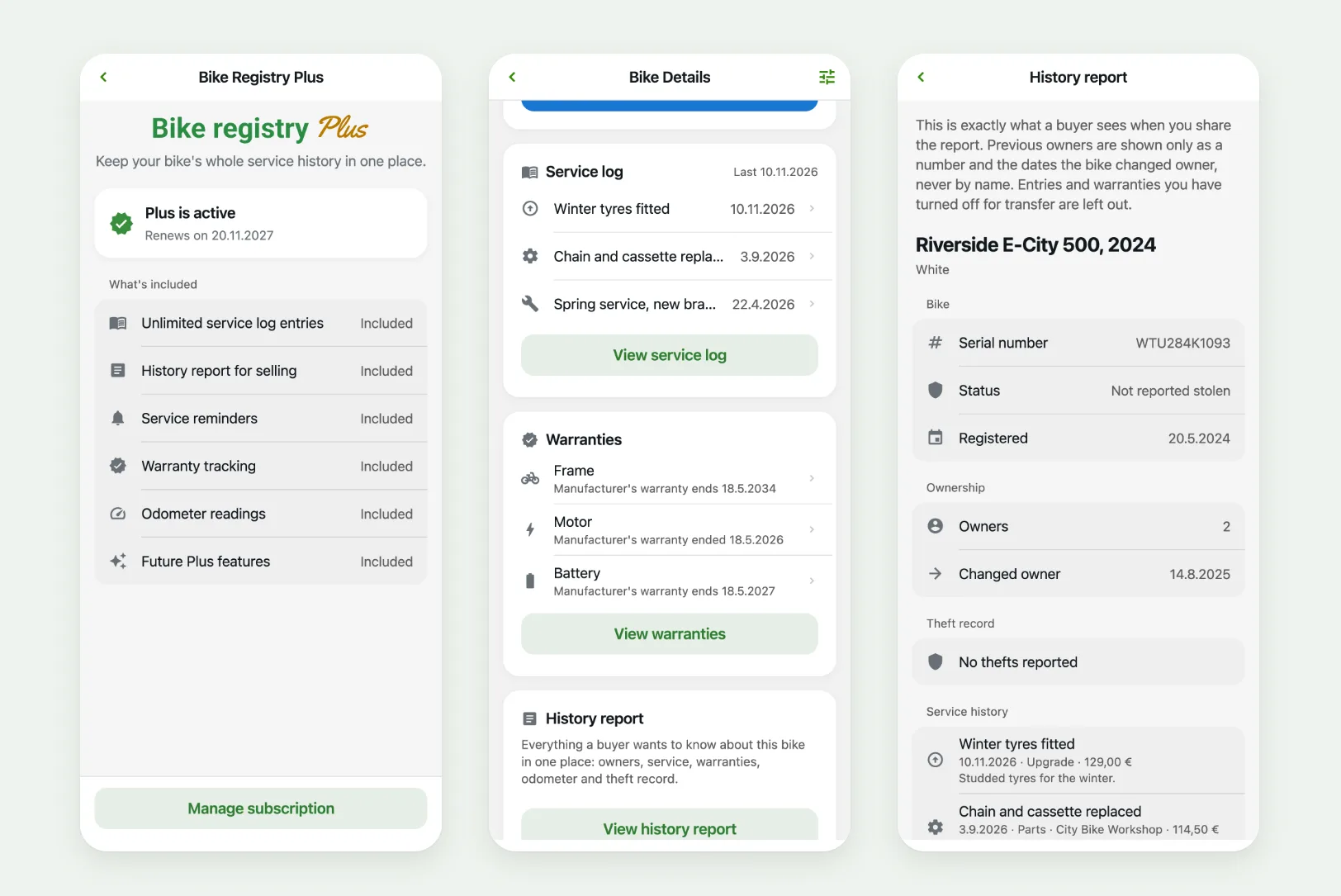
The bike is registered. It has a recorded bicycle serial number, photos, and an ownership history. That alone puts it ahead of 99% of used bike listings.
The bike is registered to the seller's account. They can only initiate a transfer for bikes under their account.
You can check the bike's history. Before you pay, you can search the serial number on Bike Registry's public search to see if the bike has been reported stolen.
You get a dated record of the handover. If your bike is ever stolen, or if you want to sell it later, it's already in your account. No digging through old emails for a receipt.
For expensive bikes, and especially e-bikes, where the average value is significantly higher, this kind of verification is worth real money. Some buyers are already willing to pay more for a bike with a documented history, just like they would for a used car with a full service record.
Why this matters for sellers
Transferring ownership isn't just a favor to the buyer. It protects you too.
The bike leaves your account in Bike Registry. It moves to the new owner's account, with a record of when that happened.
Your listing stands out. Adding "Registered on Bike Registry: ownership transfer included" to your listing signals that you're a legitimate seller. In a sea of anonymous listings, that's a real advantage.
You close the loop. Without a transfer, the bike stays registered under your name in Bike Registry indefinitely.
Think of it this way: when you sell a car, the change of keeper is recorded in the national vehicle register. A Bike Registry transfer does something similar in our register: it records that you handed the bike to the buyer, and when. It is not a state registration, and it does not change anyone's legal rights or obligations on its own. If your bike is also in an official register, record the change there too: in Latvia, for example, bikes can be registered with CSDD, and registration is mandatory for some e-bikes.
How this compares to car ownership transfers
The comparison to cars keeps coming up because it's the closest thing people understand. Here's how they stack up:
Car
Bike (no registry)
Bike (Bike Registry)
Ownership document
Registration certificate from the state
Nothing
Digital record of registration and transfers
Transfer process
Change of keeper reported to the vehicle register
Handshake
Dual-confirmation in app
Buyer verification
VIN check, vehicle history
Hope for the best
Serial number search, transfer history
Time to complete
Often the same day online, depending on the country
Instant (no process)
About 2 minutes
Cost
A fee in most countries
Free
Free
Theft protection
VIN database, police lookups
Almost none
Stolen bike database, public search
Bike Registry is not a state register and does not replace one. What it adds is a free record of the bike and its handovers, and a serial number check any buyer can run before paying, in every country we operate in.
Making summer bike sales safer
Summer is when the used bike market comes alive. People upgrade, downsize, or sell bikes they haven't ridden since last September. It's also when bike theft spikes: more bikes outside means more opportunities.
If you're selling a bike this summer, register it on Bike Registry before you list it. It takes two minutes and it's free. When you find a buyer, transfer ownership through the app. You'll both walk away with a clean, dated record of the handover. Our guide to selling a used bike safely covers pricing, payment and meeting the buyer.
If you're buying, ask the seller if the bike is registered, and check whether it's stolen: search the serial number on Bike Registry before you pay. And once you own it, keep it registered: for your own protection and for the next person down the line.
A handshake deal works until it doesn't. A recorded transfer still helps when questions come up.
Ready to protect your bike? Download the app and register your bike for free.