After months of icy roads and long nights, spring signals the return of the cycling season. Before that first ride, an hour of spring service prevents most of the failures that show up in the first warm weekend at the bike shop — flat tires, skipping gears, worn brake pads. Here's what to check and how to know when it's good enough.
Clean and inspect
Start by washing the bike. Winter road grime is a mix of salt, dirt, and brake dust; left on the frame it accelerates corrosion on steel parts and aluminium dropouts. Use mild soap, warm water, and a soft brush. Park Tool's bike-washing guide advises low-pressure water with a wide spray — high-pressure hoses drive water past the seals on hubs, bottom brackets, and headsets, and once it's inside the bearings the rust starts months before you'd notice the symptom.
Once the bike is clean, look closely at the frame for cracks (especially around welded joints and the head tube), rust on bolts, and dry seals around the bottom bracket. Catching these now is cheaper than catching them when something fails mid-ride.
Drivetrain and gears
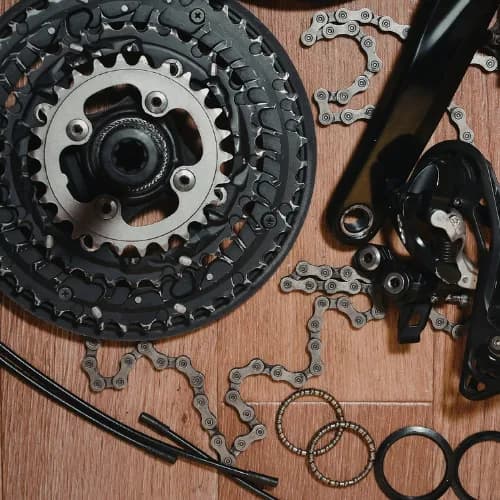
The chain is the cheapest part of the drivetrain and the most worn-out. Shimano specifies that 11- and 12-speed chains — roughly 75 mm over a 12-link section. A chain checker tool costs less than a coffee and tells you in seconds. Riding past 0.75% elongation wears the cassette and chainrings, and replacing those costs 5–10× more than the chain.
Clean the chain with a degreaser, dry it, and re-lubricate with a quality bike oil. Run through every gear while pedaling in place. If the shift hesitates or skips, the cable has likely stretched over winter — adjust the barrel adjuster or get it indexed at a shop.
Tires and wheels
Cold weather makes rubber brittle. Look at each tire for sidewall cracks, embedded glass, and dry, hard rubber. If you can see the casing through the tread or the sidewalls flex unevenly, replace the tire.
Inflate to the pressure printed on the sidewall — typically 80–120 PSI for road tires, 40–65 PSI for hybrid/commuter tires, and 25–50 PSI for mountain bikes. The pressure range is set by the European Tyre and Rim Technical Organisation (ETRTO) standard that manufacturers stamp on the casing. Spin each wheel in the frame and watch the rim against the brake pad or fork — if it wobbles more than 2–3 mm side-to-side, a spoke needs tensioning. A loose wheel costs more to ignore than to fix.
Brakes and cables
Squeeze each brake lever. There should be firm resistance, with the lever stopping at least 25 mm from the handlebar — closer than that, and the system is too slack to brake hard. Inspect the pads. Most rim brake pads have wear-indicator grooves; once those grooves are gone, the pads are done. Replacement pads cost a few euros and make a measurable difference in stopping distance.
For mechanical brakes, look at the cables for fraying near the lever and at the caliper. A drop of lubricant frees a sticky cable; if movement still feels rough, replace the cable — it's a 10-minute job. For hydraulic brakes, check that the levers don't pull all the way to the bar and that there are no fluid leaks at the caliper. If they feel spongy, the system needs bleeding.
Frame and bearings
Wiggle key parts to find loose bearings. With one hand on the front brake, rock the bike forward and back; any clunk in the headset means it needs adjustment. Hold the crank arms and pull them sideways; play means the bottom bracket bearings are worn or loose.
Tighten the bolts on the stem, seat post clamp, and wheel axles to the torque values stamped on the components — typically 4–6 Nm for stem bolts and 5–7 Nm for seatpost clamps. A small torque wrench is the difference between "tight enough" and "snapped a carbon component."
Lights, reflectors, and safety gear
Spring mornings are still dark in the Nordics. Turn on your front and rear lights to confirm they work, replace batteries or charge them, and clean the lenses. Under § 96 of the Finnish Road Traffic Act (Tieliikennelaki 729/2018), every bicycle must show a forward-facing white or pale-yellow light in dim or poor-visibility conditions and carry a red rear reflector plus white front and side reflectors. Most other Nordic and Baltic traffic laws have similar provisions.
If your helmet has taken a hard impact or is more than five years old, replace it. EPS foam loses energy-absorption performance after impact and degrades over time even without one.
When to take it to a shop
Tune-ups are bookable for a reason. Take the bike to a mechanic if the wheels are noticeably out of true, the shifting won't index no matter what you adjust, brakes still feel weak after pad replacement, or you hear creaks you can't trace. Book in early spring — by the first sunny weekend, waitlists stretch to two weeks at most shops.
Don't skip the registration check
A spring service is also a good moment to confirm the bicycle serial number is registered in a stolen bike registry and up to date. Bicycle theft peaks between May and September, and bike registration raises the recovery rate from roughly 5% to around 23% — the single biggest factor in whether a stolen bike comes home. If you've changed components, repainted, or bought a new bike over winter, update the registration at Bike Registry so the photos and details match what's currently on the bike.
A clean, well-maintained, registered bike isn't just ready for the road — it's protected and traceable when it matters.