In Finland alone, police log around 14,000 bike thefts a year. Across the Nordics the numbers run higher still, and the recovery rate sits around 2–5% without registration. Registering your bike against its serial number is the single thing that has been shown to move that number — registered bikes are recovered at around 23%, more than four times the unregistered rate. Here's exactly how to do it.
Why register at all
A registered bike is a bike a thief can't easily resell. Bike registration in a stolen bike registry that buyers, bike shops, and police can check shrinks the resale market for bicycle theft. The Swedish Crime Prevention Council (Brottsförebyggande rådet) describes the lack of a shared register as one of the main reasons stolen bikes circulate so freely on second-hand marketplaces. Registration is what closes that loop.
It also gives you something concrete to hand the police: a documented serial number, photos, and an audit trail. That matters because fewer than 1 in 8 Swedish bike theft victims actually file a police report — the most common reason cited in the underlying study is that owners don't have the documentation police ask for. Registration solves that before the theft happens.
Step 1: Download the app
Get Bike Registry from the App Store (iOS) or Google Play (Android). The app is free with no subscription. You can register as many bikes as you own from one account.
Step 2: Create your account
Tap "Sign Up," enter your email and a secure password, and verify the email. Your personal information stays private — public lookups against your bike's serial number only return whether the bike is registered or flagged stolen, never your name or contact details.
Account creation takes under two minutes.
Step 3: Find your serial number — the app guides you
In the app, tap "Register Bike" and you'll see guidance on where to look. The bicycle serial number is usually stamped into the metal under the bottom bracket (where the pedals attach to the frame). On some bikes it's on the seat tube, head tube, or rear dropout instead. Flip the bike upside down or use a flashlight if it's hard to read.
Each bicycle serial number is unique. It's how the registry — and police — identifies your bike.
Step 4: Add your bike
After entering the serial number, the app prompts for the rest:
Required:
Country — where you primarily ride
Recommended:
City — where you mostly keep the bike
Brand — Trek, Giant, Specialized, Pelago, Helkama, etc. (free text)
Model — the specific model name
Year — manufacturing or purchase year
Colour — primary frame colour
Photo — one clear shot of the whole bike
The more identifying detail you add, the easier it is for a buyer, bike shop, or police officer to confirm it's yours if it ever turns up.
Step 5: Confirm and submit
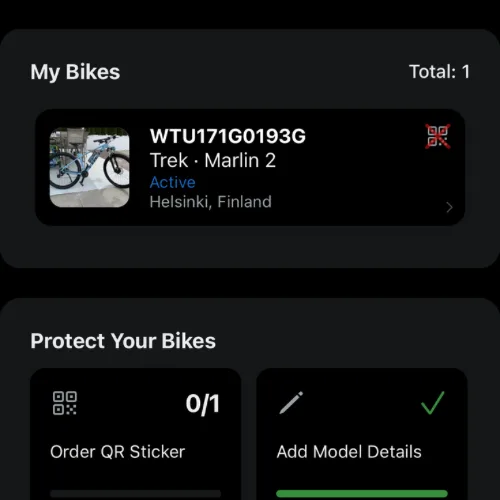
Double-check the serial number — this is the only field you can't edit after submission. Hit "Register Bike." Your bike appears under "My Bikes" immediately, logged in the registry.
After registration: a few small things that matter
Upload the purchase receipt. Under "Edit Bike" in the app, you can attach the original receipt as additional proof of ownership. This makes police reports and insurance claims faster.
Register every bike you own. There's no per-bike fee. Each registration adds another bike to the network that buyers, shops, and police can check.
Keep details current. If you repaint, change cities, or upgrade major components, update the registration. A bike that doesn't match its registered photos is harder to identify after recovery.
Report theft fast. If the worst happens, mark the bike as stolen in the app immediately. The faster the serial number is flagged, the higher the chance someone running a check spots it before it changes hands.
Common mistakes
Wrong serial number. It's permanent, so verify before you submit. If you entered it wrong, contact support.
No photo. It's optional, but a registered bike without a photo is much harder to confirm if recovered.
Forgetting to update. Repaints, modifications, and address changes all matter for identification.
Delayed theft reporting. Every hour between theft and registry flag is an hour the thief has to fence the bike.
How ownership transfers work
Selling or giving away a bike? The transfer needs to be logged so the registry knows who owns it now. In the app, generate a unique time-limited transfer code and share it with the buyer. Both parties confirm the transfer within 24 hours, creating a clean chain of custody. Without dual confirmation the transfer doesn't go through — which is what makes the system fraud-resistant.
This matters because the resale market is where most stolen bikes end up. A documented transfer chain protects both buyer and seller and, over time, makes second-hand bike marketplaces more trustworthy for everyone.
Ready to register?
Registration takes about five minutes — far less than the time it would take to deal with a stolen bike afterwards.