It's the first week of September. You wheel your bike to the lecture hall, loop a cable lock around the front wheel, and head inside. Ninety minutes later, you walk out to an empty rack. The cable has been snipped clean — your bike is gone, along with your main way of getting around a new city.
This scene plays out thousands of times every autumn across Nordic university campuses. Students arrive with bikes and cheap locks, park in predictable locations at predictable times, and leave campus property sitting unattended for hours. Thieves know this. The start of term is their busiest season.
Why university campuses are theft hotspots
Campuses concentrate large numbers of bikes in a small area, often locked to outdoor racks with minimal security. A study at Indiana University found that only 36% of stolen bikes had been registered — meaning the vast majority of student bikes have no traceable record at all.
Several factors make campuses particularly vulnerable:
Predictable schedules. Lectures, labs, and library sessions follow fixed timetables. A thief can observe when racks fill up and empty out, then strike during the window when nobody is around.
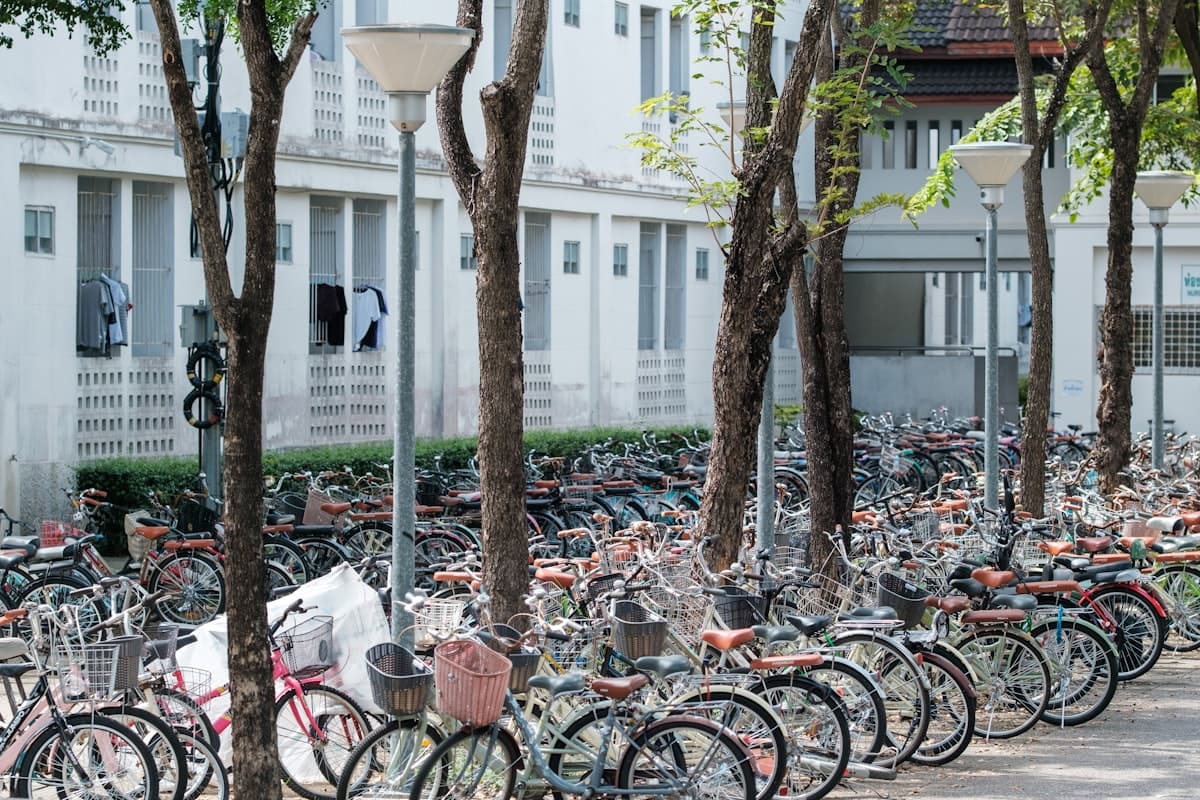
High bike density. Rows of bikes parked tightly together give cover. A thief crouching between bikes with bolt cutters draws less attention than you'd think.
Cheap locks. Students on tight budgets often buy the cheapest lock available. Cable locks — the most common type on campus — can be cut in under three seconds with basic hand tools.
Transient population. New students don't yet know which areas are high-risk. By the time word spreads about thefts near a particular building, the semester is already underway.
Limited surveillance. Many bike racks sit in poorly lit areas behind lecture halls or between buildings, outside the view of security cameras.
Nordic university cities: where students lose the most bikes
Cycling is the default mode of transport in many Nordic university towns, which also makes them prime territory for theft.
Oulu, often called Finland's cycling capital, sees 1,700 bikes reported stolen in a typical year. With the University of Oulu's 13,000+ students relying heavily on two wheels — even through the snow — bike racks near campus are packed from September through May. Police there note that the city centre and areas around the university are the riskiest spots.
Turku and Jyväskylä follow similar patterns: compact cities where students cycle everywhere, and where bike parking near campus buildings offers easy pickings for opportunistic thieves.
In Sweden, Lund stands out. The city is practically defined by its university and its cycling culture. Skåne, the region where Lund sits, has been called Sweden's bike theft capital — a distinction that students arriving at Lund University discover quickly. Uppsala, home to Scandinavia's oldest university, has the same combination: flat terrain, heavy bike use, and bike racks that stretch the length of entire buildings. Gothenburg rounds out the list, with a growing student population at both Chalmers and the University of Gothenburg feeding demand in an already theft-heavy city.
Common mistakes students make
The first few weeks of term are when students are most vulnerable. Here are the errors that show up again and again:
Using only a cable lock. This is the single most common mistake. Cable locks are not security — they are a minor inconvenience to a thief with a pair of pliers. Yet cable locks remain the most popular choice among students because they're cheap and lightweight.
Locking the wheel but not the frame. A quick-release front wheel detached from a cable-locked bike takes seconds. If the frame isn't secured, the thief walks away with the most valuable part.
Leaving the bike in the same spot all day. Parking at the same rack from 8am to 5pm every weekday tells a thief exactly how long they have to work. Vary your parking when you can, and bring your bike inside if your building has indoor storage.
Ignoring the bike over weekends. A bike left at a campus rack from Friday evening to Monday morning is a sitting target. Thieves test locks over the weekend when fewer people are around.
Not recording the serial number. Your bike's serial number — stamped on the bottom of the frame — is the single most important piece of information for recovery. Without it, police have almost no way to match a recovered bike to its owner.
Lock recommendations on a student budget
You don't need to spend EUR 200 on a lock, but you do need to spend more than EUR 15. Here's what works without breaking a student budget:
EUR 50-65: Kryptonite Evolution Mini-7. A compact U-lock with a Sold Secure Silver rating. It fits in a backpack and resists bolt cutters. This is the minimum viable lock for campus use.
EUR 80-100: Abus Granit X-Plus 540. Sold Secure Gold rated, with a 13mm parabolic shackle that resists both bolt cutters and prying attacks. At 1.4 kg, it's light enough for daily commuting. This is the sweet spot for students with a decent bike.
Add a secondary cable: EUR 10-15. Thread a cheap cable lock through your front wheel while the U-lock secures the frame and rear wheel to the rack. Two locks force a thief to carry two different tools, which most won't bother with.
Locking technique matters as much as the lock itself. Fill the U-lock's shackle space — a tightly fitted lock leaves no room for a leverage attack. Lock through the frame and rear wheel, with the keyhole facing down to prevent picking. Always lock to a solid, immovable rack, never to a fence, sign post, or tree.
Registration: a student essential
A lock prevents theft. Registration helps you get your bike back when prevention fails — and on a campus, it will fail eventually for someone.
Research shows that registered bikes have significantly better recovery prospects. A North American study found a 15% overall recovery rate when theft was reported through multiple channels — compared to roughly 5% for unregistered bikes. The difference comes down to proof: a registered bike has a documented serial number, photos, and a clear ownership record that police can verify instantly.
Bike registration takes two minutes and costs nothing. Open the Bike Registry app, scan or type your serial number, snap a few photos, and your bike is in the system. If it's ever stolen, you mark it as stolen in the app — and anyone who searches that serial number (a buyer, a police officer, a second-hand shop) will see immediately that the bike is reported stolen.
For students, this matters more than for most people. You're new to a city, you might not have the original receipt, and you might not even know your bike's serial number off the top of your head. Registering on day one means you have everything documented before anything happens.
What to do if your bike is stolen on campus
Speed matters. According to a UK survey of convicted bike thieves, two-thirds of stolen bikes are sold within hours of being taken. Here's how to move fast:
Check your registration. If your bike is in Bike Registry, open the app and mark it as stolen immediately. This flags the serial number in the database for anyone searching it.
File a police report. In Finland, you can report a theft online at any time. In Sweden, file via Polisen.se. You'll need the serial number, a description, and the location and time of theft.
Report to campus security. University security teams often recover abandoned bikes on campus grounds. Give them your serial number and description so they can flag it if it turns up.
Contact your insurance provider. If you have home insurance (or your parents do), bicycle theft is often covered. Student housing insurance through providers like If, LähiTapiola, or Folksam may include bicycle coverage — check your policy.
Search online marketplaces. Stolen bikes frequently appear on Tori.fi, Facebook Marketplace, and Blocket within days. Search by brand, model, and colour. If you find your bike, contact the police — do not try to recover it yourself.
Alert your campus community. Post in student groups on Facebook, Telegram, or your university's messaging channels. Student networks are tight — someone may spot your bike.
The first 24 hours are critical. After that, recovery rates drop sharply. This is exactly why having your serial number and photos already stored in a registration app matters — when the clock is ticking, you don't want to be searching for paperwork.
Ready to protect your bike? Download the app and register your bike for free.