Stolen bikes do come back, but rarely by luck. In the published cases below, a bike went home when two things met: someone found it (a police stop, a witness, the owner checking second-hand listings) and the bike could be proven to belong to someone, almost always through a recorded frame number on a police report or in a register. When the second half was missing, police ended up holding stolen bikes they could not return. So the best thing you can do for stolen bike recovery happens before any bike theft: photograph the bicycle serial number, keep photos and the receipt, and report a theft with those details straight away.
What does research say about stolen bike recovery?
Reliable numbers are scarce, and most of them come from North America. The best-known study, published in Findings, surveyed 1,823 theft victims in the United States and Canada, recruited mostly through the Bike Index registry. About 15% of the stolen bikes were recovered.
Among the owners who did get a bike back, the route differed. Registered owners more often recovered it through the police, 38% against 32% for unregistered bikes, while unregistered owners relied more on online channels, 24% against 16%. That is one survey of one population, not a promise, but it fits what police in Europe say: a record of the bike gives them something to match against.
Which stolen bikes came back, and why?
These are published cases from police releases and news reports in the UK, Sweden, Germany and Finland. Each one is summarised from its source.
London, 2014: a pavement stop and a registered frame number
Officers in east London stopped a 19-year-old cycling on the pavement on Bethnal Green Road. PC Tom Newell checked the frame number, and it showed the bike had been reported stolen in Hounslow, about 13 miles away, and recorded on the BikeRegister database. The bike was returned to its owner and the man was arrested on suspicion of handling stolen goods, road.cc reported. Acting Police Sergeant Scott Manning said the case "shows the value of recording frame numbers".
What made the difference: the theft was on record against the frame number, so a routine stop could end in a match.
Uppsala, 2026: the owner spotted her bike, the report proved it
In June 2026 a woman saw a man at Uppsala's travel centre riding her recently stolen bike and called the police. According to the Swedish Police event report, officers used the theft report and the bike's frame number to establish that it was stolen, and the man riding it was suspected of handling stolen goods.
What made the difference: a theft report already on file and a frame number to check it against. Without them, the owner's word would have been all there was.
Helsinki, 2020: the owner checked the listings
A bike stolen from a yard in Myllypuro turned up in an online sale ad. The owner arranged to meet the seller, but the police went to the meeting instead and arrested him. A search of his flat found 30 suspected stolen bikes or frames, MTV Uutiset reported. At the time of the report, police had identified the owners of three of them. The investigation leader's advice was to make a bike identifiable and to put those identifying details in the police report.
What made the difference: the owner searching second-hand listings and leaving the meeting to the police. The other 27 bikes and frames, still without a known owner when the story ran, show the other half of the problem.
Magdeburg, 2023: a witness tip and a van of bikes
In May 2023 a witness told Magdeburg police that a stolen cargo bike was inside a van. Officers stopped it at a petrol station and found more than 20 bikes. In a follow-up release, police said they had matched five to their owners so far. They used the moment to remind owners to give the frame number when reporting a theft, and since frame numbers are often missing from receipts, to photograph it after buying a bike.
What made the difference: a witness, then the police matching five bikes to their owners.
Southwest Finland, 2023: 80 bikes, and owners who could not be found
Police in Southwest Finland investigated two people suspected of reselling more than 80 stolen bikes between January 2022 and May 2023. Police could not reliably link the seized bikes to reported thefts, because people reporting a theft often did not notice or could not give the identifying details of their own bike, Verkkouutiset reported. Police also suspected some thefts were never reported at all.
What made the difference: here, the absence of it. The bikes were found; the owners could not be proven.
Place
Year
Who found it
What decided the outcome
London, UK
2014
Police on a routine stop
Frame number on record, bike returned
Uppsala, Sweden
2026
The owner, then police
Theft report plus the frame number
Helsinki, Finland
2020
The owner, in an online ad
Owner checked listings; 3 of 30 seized bikes matched at the time
Magdeburg, Germany
2023
A witness, then police
Witness tip; 5 of 20+ matched to owners
Southwest Finland
2023
Police investigation
Missing identifying details; bikes could not be linked
What do the recovered bikes have in common?
Read side by side, the cases split recovery into two steps.
Someone has to find the bike. In these cases that was a police officer on an unrelated stop, a witness, or the owner checking second-hand listings. You cannot control the first two, but you can do the third, and you can make sure the bike is reported so that the people who do find it know it is stolen.
Then someone has to prove whose it is. This is where most recoveries are won or lost, and it is the part you control in advance. The Swedish Police put it simply: note the frame number, give it to the police if the bike is stolen, and the chance that they can identify it and give it back goes up. Magdeburg's and Helsinki's police said the same in their own words. The Southwest Finland case is what happens without it: dozens of bikes in police hands, and no way to tell whose they are. Our guide on why police need your serial number goes into how that matching works.
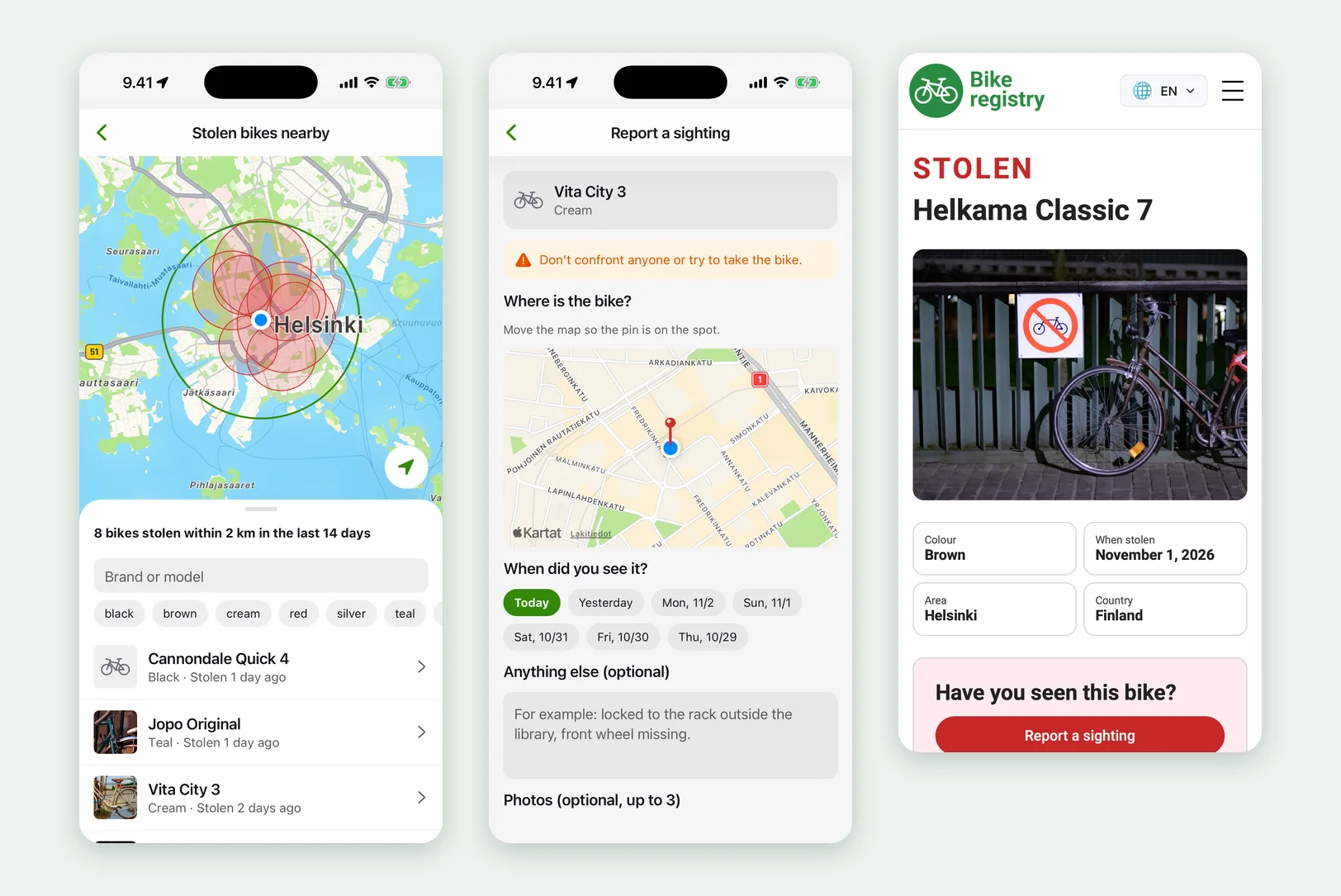
A register helps with both steps. In London the frame number was already on BikeRegister, a UK database the police check. With Bike Registry, your bike registration keeps the frame number, photos and receipt in one place. When you mark the bike stolen, anyone with a free account who checks that number in the app sees that it is stolen, and you are notified that someone searched for it.
How can you give your bike the best chance of coming back?
This is the bike theft prevention that pays off after the theft. It takes about ten minutes per bike.
Photograph the frame number. It is usually under the bottom bracket. Our guide shows where to find your bike's serial number on different frames. A photo avoids misread characters.
Photograph the whole bike from both sides, plus anything distinctive: stickers, scratches, non-standard parts.
Keep the receipt, or for a private sale, the messages and the seller's details.
Register the bike so the frame number, photos and receipt are stored together and can be reached from your phone when you need them.
Know your local marketplaces, so you can search them quickly if the bike goes missing.
What should you do if your bike has already been stolen?
Act on the same day. Stolen bikes are resold fast, and most of the cases above depended on a report that already existed when the bike was found.
Report it to the police with the brand, model, colour, frame number and distinguishing marks. If you have no frame number, look for it on the receipt, an old sale ad or the shop's records.
Mark it stolen in your register so a frame number check shows it.
Search second-hand listings in your area every day for the first weeks.
If you spot your bike, call the police. Do not take it back yourself or meet the seller alone. The Swedish Police tell owners to contact them before taking back a bike they reported stolen, and in Helsinki the police went to the meeting instead of the owner.