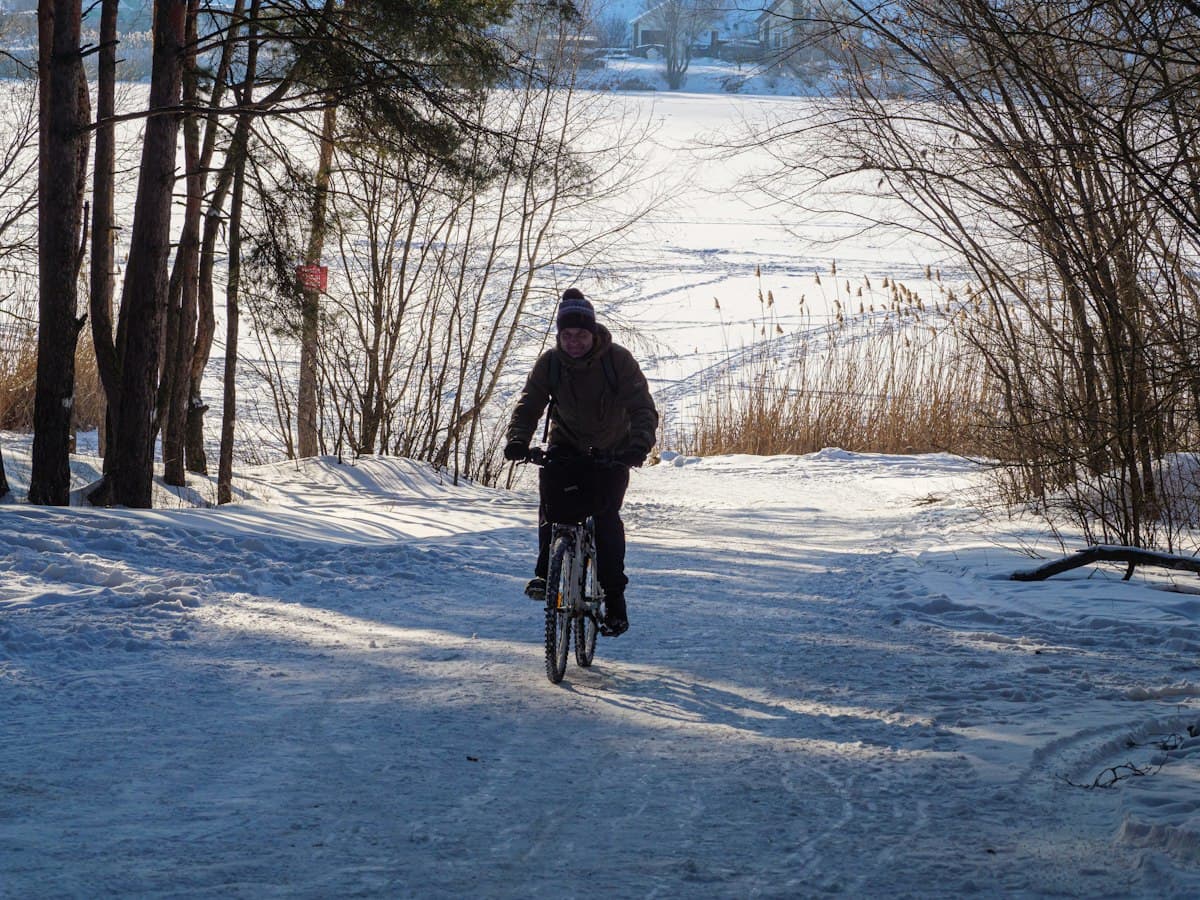
Oulu is 200 kilometres short of the Arctic Circle. In February its cycleways are white, and the counter on the Raatti bridge still logs an average of 1,118 cyclists a day.
The easy explanation is that Finns are hardy. The people who run the city reject that explanation flatly, and their own numbers back them up. Winter cycling in Oulu is a maintenance programme with a budget line, not a character trait.
Here is what they actually do, and which parts of it travel.
Five bridges, over 800 cyclists a day, in midwinter
The city's 2024 walking and cycling report counts the traffic directly. Across December, January and February, five separate crossings each averaged more than 800 cyclists a day. Raatti managed 1,118 against a summer figure of 3,287, and Patosilta 1,002 against 3,152.
So winter traffic runs at roughly . That is a real drop, and it is also a far smaller drop than most cities would expect from a place where the sun barely clears the roofs in January. Across the Oulu region, , and around 10% in winter.
The counter data contains one genuinely surprising finding. Cycling numbers barely move between a few degrees above freezing and about minus ten. The sharp break is at plus ten, not at zero. People are not deterred by cold. They are deterred by conditions, and conditions are a service.
A single image makes the point better than the averages do. At Metsokangas school, served by a main route with enhanced winter maintenance, a count in January 2021 found 1,200 bicycles in the schoolyard, almost as many as in summer.
What "maintained" means when it is written into a contract
Most cities say they clear their cycleways. Oulu specifies it, and the specification is the interesting part.
Main routes sit in maintenance class Super, which covers just over 10% of the network. The contract terms are precise: ploughing is triggered at 2 cm of snow, the response time is three hours, and the snow depth on the path is never allowed to exceed 4 cm except in exceptional snowfall, defined as more than 20 cm in four hours. Lower classes trigger at 3 cm and 5 cm.
Three details show how much of this is about the bicycle rather than the snow:
Plough ridges must stay under 20 mm. A ridge taller than that steers a front wheel, which is how a cleared path still throws you off.
Flat blades are prohibited, and sharp aggregate that punctures tyres is contractually banned.
Packed snow is allowed to 5 cm until 14 March, then 2 cm. The goal is not bare asphalt.
That last one is the biggest departure from how most cities think. Oulu does not salt its cycleways. Grip in established winter comes from a smooth, compacted snow surface, and where that surface holds, sand is not needed at all. Salt also rusts bicycles, which matters when you are maintaining a route for them specifically.
The whole main-route programme costs about €3,200 per kilometre per year, roughly €400,000 in total.
The cycleways get ploughed before the roads
This is the part people find hard to believe, and it is official policy rather than folklore. Harri Vaarala, a traffic engineer for the city, has stated plainly that ploughing snow from the cycling paths is prioritised above ploughing the roadway, and that main cycle routes are cleared before the morning commute.
It is also not an expensive indulgence. Vaarala has pointed out that Oulu spends more on resurfacing road asphalt than on winter maintenance of all its cycleways put together, and that the city does not spend more on this than comparable Finnish cities do. Ploughing a road, including carting the snow away, costs more than ploughing a path.
What makes the system work is less glamorous than the budget. Contractors' drivers ride the routes they plough. Client and contractor do joint rides, because a path can look immaculate from a car window and be unrideable on two wheels. Quality assessment has shifted from chasing centimetre thresholds to resident "cycling agents" whose ratings feed contractor bonuses.
"For people to keep cycling through the winter, they have to be able to trust that the maintenance works. The weather varies and there is nothing you can do about that, but the road conditions are purely the result of maintenance."
Here the evidence overturns the usual assumption, which is that winter danger means traffic.
A study of 3,449 commuter bicycle accidents in Finland, presented by Roni Utriainen of Tampere University, found that 63% were caused by the infrastructure rather than by anyone's behaviour. Skidding on a slippery surface accounted for 47%, with ice and snow specifically behind 30%. Only 15% involved another road user at all, and a motor vehicle featured in just 6%.
The seasonal split is the useful bit. The number of accidents is roughly the same in summer and winter, but the causes differ completely: infrastructure explains around 85 to 89% of winter accidents against 38 to 46% in summer. Since far fewer people ride in winter, the same absolute count means the risk per trip is markedly higher.
Which brings up studded tyres, and a caveat worth stating honestly. Nobody has measured how much studded bicycle tyres reduce real-world crashes. What exists is a Swedish laboratory test, VTI report 862, which found up to 2.5 times more friction on smooth ice than an unstudded reference tyre, roughly halving braking distance. Separately, a peer-reviewed Swedish modelling study put the preventive potential of studded bicycle tyres at 12%, the joint highest of any measure assessed, with better winter maintenance at 8%.
And yet about two-thirds of Oulu's winter cyclists do not use studs. Vaarala's explanation is the thesis of this entire article: for most of the winter, on a properly maintained surface, ordinary tyres are enough. Equipment compensates for conditions. It does not replace them.
Your bike is safer in winter. Your storage room is not.
Theft follows the same seasonal curve as cycling, and the effect is large. Danish police data covering 1,067,279 bicycle thefts from 2007 to 2025 shows the third quarter running 60% above the first. Our own analysis of Berlin's open police dataset found the peak month at 2.06 times the trough.
But the floor is high. Winter still sits at roughly 55 to 65% of the summer peak, so theft does not stop, it thins out. And when we broke the Berlin figures down further, something more useful appeared. Overall theft falls 38% from summer to winter, but theft from cellars and attics falls only 27%. As a share of all thefts, the storage room climbs from 4.57% in May to 7.24% in December.
The risk does not disappear when you put the bike away for winter. It relocates, into exactly the room you moved the bike to. We covered the locking side of that in apartment bike storage.
The documentation side takes five minutes and is the thing people skip. Finland's police put it bluntly: with a serial number they can circulate a stolen bike, and without one it may be impossible to connect a recovered bike to its owner. Before the bike goes into the cellar for the winter, make sure its frame number, photos and ownership record exist somewhere other than your memory. If you are not sure where the number is, here is where to look.
Oulu's lesson is not that you should buy better tyres. It is that winter cycling is a thing cities decide to have, and the cities that decide to have it write down the number of centimetres at which the plough goes out.
Five minutes, free: register your bike so the details exist before you need them. Heading into the cold season, the autumn cycling checklist covers lights and visibility.